Where the Kettle Slows You Down: Tea Houses and the Case for a Better Third Place
A coffee shop can be a wonderful place. It is fast, familiar, and easy to find. But there is a difference between a place where you stop and a place where you settle. Tea houses, at their best, belong to the second category. They are not an antidote to coffee so much as an antidote to the quick stop being our only option.
The case for tea-house culture is not about which beverage is better. It is about what a room asks of you. A coffee counter often asks for a decision, a line, a name on a cup, and a seat if you are lucky. A tea house can ask something slower: sit down, wait for the steep, take the first pour, and see who else is at the table.
The Third Place, Briefly
The sociologist Ray Oldenburg popularized the idea of the third place: a gathering spot that is neither home nor work. It is the neighborhood café, the barbershop, the library, the pub, the park. These places matter because they let people be alone together without a formal reason to gather.
In the US, coffee shops became the default third place for a lot of towns. That is not a failure. Many coffee shops do the work of a community room with remarkable grace. But the quick-stop model has limits. When the business depends on turnover, lingering can feel like a problem even when nobody says so. The room may be comfortable, but the rhythm is often pointed toward the door.
What the First Pour Changes
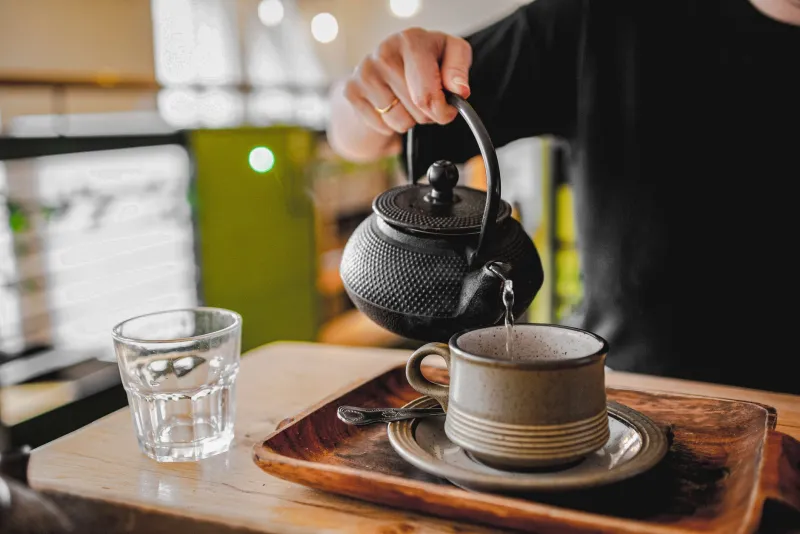
Tea has a built-in pause. The leaves need water. The water needs time. The first cup is often not the best cup; it is the opening. That small delay is a gift to a gathering. It gives the host something to do and the guest something to wait for.
In a good tea house, the first pour is not a performance. It is a signal. The server may bring the pot to the table, explain how long to steep, and leave you alone. Or they may pour the first cup and set the timer. Either way, the ritual says: this is not a transaction to rush. This is a cup to notice.
That ritual also creates a shared reference point. Strangers at a communal table can talk about the tea without forcing a conversation about work or weather. The first pour gives everyone a small, neutral place to begin.
The Room Is Part of the Hospitality
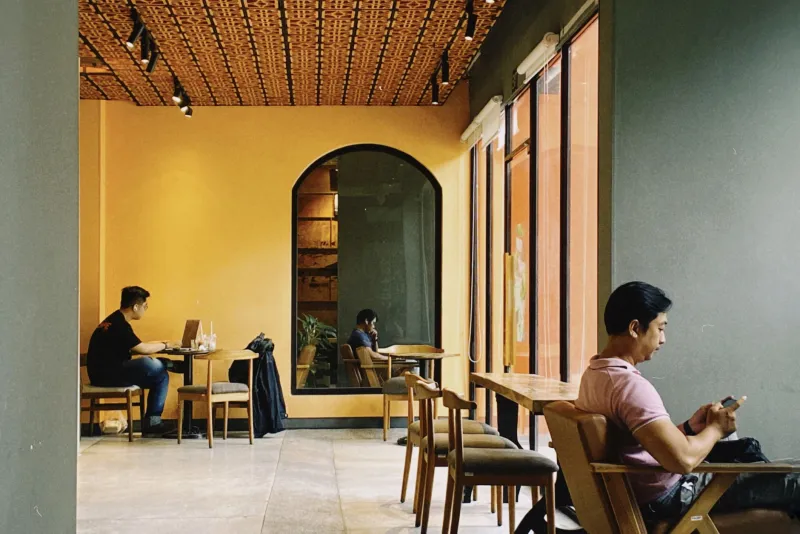
A tea house that means it pays attention to the room. The tables are not all two-tops. There is a communal table, or at least a long counter where people can sit side by side. The acoustics allow a quiet conversation. The service is unhurried but not neglectful. Water gets refilled. The pot gets a second round. Nobody hovers.
This is a delicate balance. Unhurried service is not the same as slow service. It is a form of respect: the staff trusts you to know when you need something, and you trust them to be there when you do. That trust is part of why tea houses can feel more like a living room than a café.
Why the Quick Stop Isn’t Enough
Convenience has real value. A quick coffee can be a small mercy on a hard morning. But a town made only of quick stops leaves people without a place to land. In 2026, many of us are trying to rebuild casual social ties after years of scheduling everything. A tea house offers a low-pressure way to do that. You do not need a reservation, a reason, or a full meal. You need a pot and a table.
The quick stop also has a purchase ladder. Buy a drink, find a seat, maybe buy another drink if you stay. A tea house can work the same way, but the pot changes the math. One pot can last an hour. That is not a loophole; it is the point. The pace invites you to stay long enough for a conversation to become something more than small talk.
How to Recognize a Tea House That Means It
You can usually tell within a few minutes. Look for a tea list that is more than a row of flavored bags. Listen for staff who can tell you how long to steep a green tea without reading from a card. Notice whether there is a communal table and whether anyone is using it. Check the seating: are there comfortable chairs, or only stools designed for a quick exit?
A good tea house is not necessarily fancy. It may be a small shop with a few tables and a limited menu. It may serve only tea and shortbread. The test is whether the room is built for the cup in front of you, not for the next customer in line.
Support the Third Place You Want
If you find a tea house like this, treat it like the community resource it is. Order another pot. Tip well. Join the communal table when it is open. Ask questions about the tea, but do not turn the staff into a search engine. Be the kind of guest who makes lingering feel welcome rather than entitled.
You can also recreate a little of that hospitality at home. Make the first pour a ritual. Set out a pot and a few cups. Invite people without an agenda. Let the table stay messy for a while. The third place does not have to be a commercial space; it can be a habit.
The Steep Is the Invitation
The tea-house model is not a cure for every social problem, and it is not the only good third place in town. But it offers something American communities could use more of: a room where the pace is set by the steep, not the line. Where the first pour is an invitation, not a transaction. Where you can sit with strangers and not have to explain why you came.
That is worth protecting. And it is worth building, one pot at a time.