From Sweet Tea to Samovar: Six American Tables That Pour Slower
Ask an American about tea and you will usually get one of two answers: a glass of iced tea, or a slightly apologetic sentence about how they mostly drink coffee. Both answers are a little off. The country is thick with tea tables. They just do not advertise themselves as such.
What follows is a small road trip. Six traditions, most of them rooted in communities that brought their tea habits here and kept them, all of them worth a detour and all of them generous with lessons about how to host. Borrow freely. The point of a shared table is that it does not stay put.
Sweet Tea: The Pitcher as a Standing Invitation
Start in the South, because any honest survey of American tea has to.
Sweet tea in a Southern home is not a beverage order; it is a household condition. There is a pitcher in the refrigerator, and the pitcher is expected to be full. The sugar goes in while the tea is still hot enough to dissolve it, and the strength is a matter of family doctrine, defended accordingly.
What to notice as a guest: nobody asks if you would like a glass. A glass appears. Refills happen without ceremony. The pitcher itself sits on the counter as a continuous, wordless offer.
Menu cue: something salty and fried, ideally, or a plate of pimento cheese and crackers. Sweet tea wants a counterweight.
Borrow this: the standing pitcher. Whatever your house drink is—iced tea, lemonade, a pitcher of water with cucumber in it—leave it out and full rather than serving it in individual portions. It changes a table from a service into a place people can help themselves.
Yum Cha: When the Cart Sets the Pace
Head to the dim sum halls of San Francisco, New York, Chicago, or the San Gabriel Valley, and you find the most disciplined tea culture in the country operating under an assumed name.
Yum cha literally means drink tea, and the food is the accompaniment. The first thing that happens at a good table is the pot arriving and someone rinsing the cups with hot water. Then the carts begin their loop, and the meal acquires a rhythm nobody has to manage. You eat what passes. You talk in the gaps. Your cup gets refilled by whoever is nearest and least self-conscious about reaching.
Menu cue: har gow, siu mai, a plate of greens, and a pot of something floral—jasmine or a light oolong. Order slightly less than you think you need. The carts will come around again.
Borrow this: the rolling pace. At your own dinners, consider serving in waves rather than all at once, so the table has something to do with its hands between courses. A pause with a purpose is easier to sit inside than a pause that feels like a delay.
The Samovar Table: Tea That Never Stops Being Warm
In Brighton Beach and parts of Chicago and Cleveland, in Russian-American and Ukrainian-American homes, you will meet the samovar—a tall, faintly imperial object that keeps water at a rolling heat for the entire evening.
It solves a problem most hosts know well: tea goes cold while people talk. The samovar simply does not permit that. Concentrated tea goes into a small pot on top; hot water comes from the tap below; you dilute to your own strength and refill whenever you like.
Menu cue: something to nibble across several hours rather than one plated course—pickles, dark bread, smoked fish, jam stirred into the tea, a plate of cookies that stays out.
Borrow this: decouple the tea from the meal's schedule. Make a pot of concentrate and set out a kettle of hot water beside it so guests can build their own cup, at their own strength, at their own hour. It is the single lowest-effort upgrade a dinner table can get.
Mint Tea, Poured From a Height
In Moroccan-American homes from Boston to Los Angeles, tea is a performance of generosity, and the performance is the point.
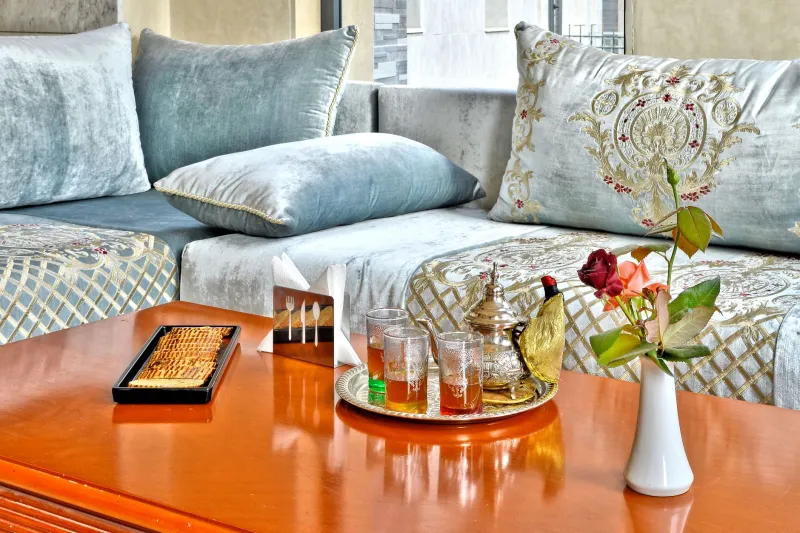
Green tea, a great deal of fresh mint, sugar to taste, and then the pour—from high above the glass, which aerates the tea and puts a fine foam on top. It is poured in rounds. The first glass is gentle, the second firmer, the third bolder. Refusing is nearly impossible, and that is part of the ritual's charm.
Menu cue: sweet, fragrant food that can handle the mint—pastries with almond, orange, honey. Or nothing at all. Mint tea is perfectly capable of carrying a visit by itself.
Borrow this: the pour. A visible, slightly theatrical gesture at the table gives the host something to do with their hands and gives the guests something to watch. It also slows everything down by about ten seconds, which is often all a table needs to find its next topic.
The Chai Kitchen and the Rolling Boil
In Edison, New Jersey, or Devon Avenue in Chicago, or any number of South Asian-American kitchens, chai is not steeped—it is boiled. Milk, water, black tea, cardamom, ginger, sometimes clove, all together in the pot and cooked down until it darkens and thickens.
The hospitality logic is the interesting part: chai is offered on arrival, before anything else, and again whenever the conversation hits a lull. There is no occasion too small for it and no guest too casual. Someone will ask how much sugar you want, and they will mean it.
Menu cue: biscuits, rusks, samosas, a tin of something savory nearby. Chai is a conversation lubricant, not a course.
Borrow this: the arrival cup. Instead of greeting guests with a drink they assemble or order, hand them something warm and finished the moment they walk in. It resets the tone of the first ten minutes, which are usually the most awkward ones.
Persian Tea and the Sugar Cube
In Tehrangeles—the stretch of Los Angeles around Westwood that holds one of the largest Persian communities outside Iran—tea arrives clear, strong, and unhurried, usually with a bowl of sugar cubes and possibly some saffron rock candy.
The technique is worth learning: you hold the cube between your teeth and sip the tea through it, so the sweetness arrives in the sip rather than dissolving in the glass. The result is a long, slow, faintly meditative way to drink that makes a second cup all but inevitable.
Menu cue: fruit, nuts, dates, maybe a plate of tahdig if the evening is going long, and small glasses rather than mugs so the tea stays hot.
Borrow this: the small glass. Serving tea in small quantities forces refills, and refills force interaction. It is a quiet structural trick—an excuse to keep passing something around the table all night.
What These Tables Have in Common
Six traditions, six sets of flavors, and nearly identical instincts underneath.
None of them treat tea as a finale. It shows up at the beginning, gets refilled in the middle, and outlasts the food. None of them require a formal host performance—the gestures are simple and repeatable. And all of them make the table a place you can stay a little longer than the meal strictly needs.
That is a portable lesson. You do not have to run out and buy a samovar. You just have to leave the pot where people can reach it, put out something small to eat that nobody has to commit to, and be willing to let the last cup go a little cold while somebody finishes a story.
The road trip, in other words, ends at your own kitchen, which is where it was headed the whole time.